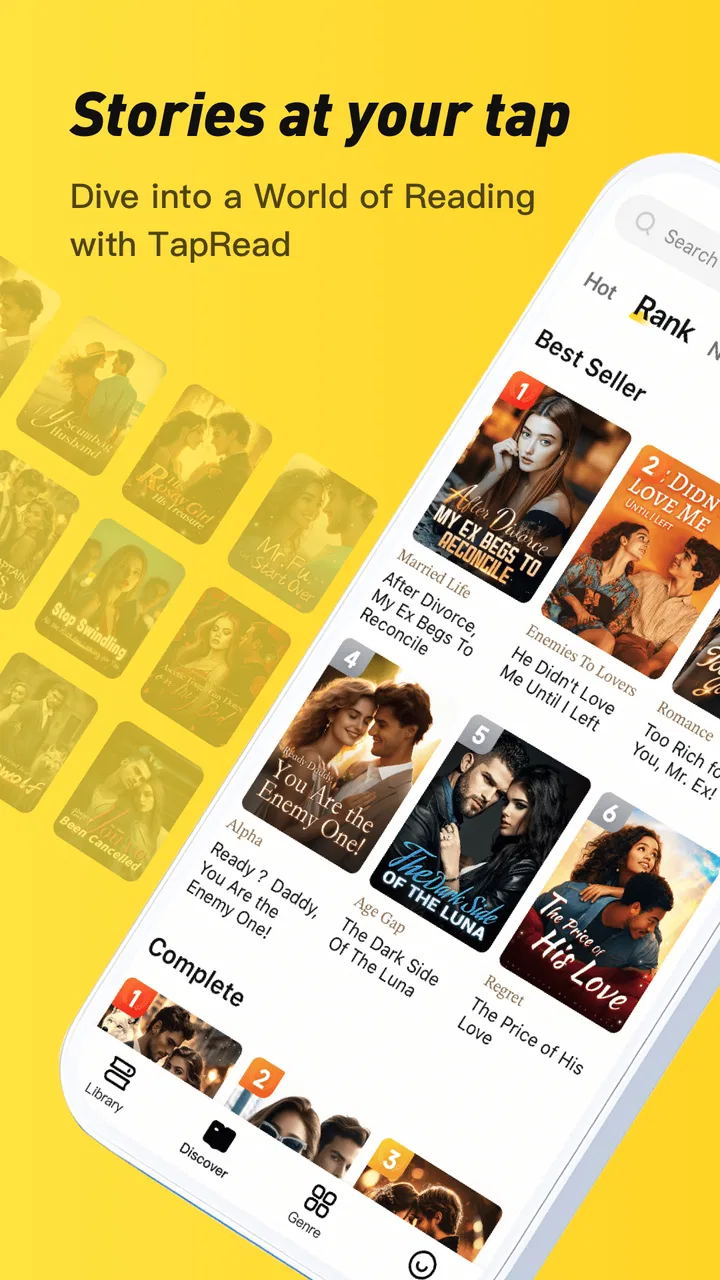
TapRead - Read Good Story
- 3.9
- Rating
- 1.00M
- Installs
- Free
- Price

 Analysis by App-foxy
I approached TapRead - Read Good Story as a reader looking for something more flexible than a single long novel. After spending time with it, my impression is that it is best understood as a mobile reading shelf built around ongoing stories, quick browsing, and the habit of returning for another chapter whenever I have a spare moment. It belongs to the Books & Reference category, is free to install, and comes from ZONGHENG CULTURE, INC.
That combination makes it appealing to people who enjoy discovering fiction rather than arriving with one specific title in mind. I can open it when I want a new story, scan through different possibilities, and settle into a serial reading routine. At the same time, it is not the ideal replacement for every reading app. Someone who mainly wants public-domain classics, professionally edited ebooks, or a quiet library for books they already own may find a conventional ebook reader more suitable.
How TapRead feels in everyday use
The strongest part of the experience is the sense of an expanding reading queue. Instead of treating reading as a single-book activity, the app encourages me to move between stories according to my mood. That is useful after work, during a commute, or before bed, when I may want a few chapters but not necessarily the same kind of fiction every time.
You May Also Like

 Blood Strike: 2.5 Anniversary
Blood Strike’s Loadouts Turn Every Drop Into a Tactical Gamble
A close look at Blood Strike’s custom loadouts: how fast access to signature weapons reshapes its battle royale rhythm, rewards preparation, and narrows the gap between fights.

 Pandora - Music & Podcasts
Pandora’s Music Is Easy to Start, but Harder to Recover
Pandora’s strength is its low-effort path from a seed to a station. Its weak spot is how much confidence it asks you to place in connection, setup, and quiet recovery.

 8 Ball Pool
 Is Built on Rivalries, Rematches, and Routine
A close look at the rivalries, rematches, shared routines, and unanswered safety questions that turn a quick pool match into a persistent mobile community.

 Samsung Music
’s Quiet Strength Is Playing What You Already Own
Its reach comes less from spectacle than from dependable access to a personal library. That simplicity is both the app’s strongest retention engine and its ceiling.

 AccuWeather: Weather Radar
AccuWeather Review: A Quick, Clear Forecast for Everyday Decisions
For everyday plans, the best forecast is the one you can understand quickly. AccuWeather makes rain timing, radar, and local conditions easy to act on, with a few trade-offs.

 Hill Climb Racing
Why Hill Climb Racing Still Turns Crashes Into One More Run
A tiny car, a bumpy hill and one more upgrade: Hill Climb Racing keeps resurfacing because its simple chaos makes every near-miss feel personal.
More From Our News Desk



A realistic routine would be to browse during a lunch break, open a promising story, and continue it later in the evening. The app’s value in that situation is not just access to text; it is the reduced effort involved in choosing what to read next. Readers who like serialized fiction can benefit from that rhythm because a story can become part of a daily habit instead of something I need to schedule a long session for.
I also see why the service has attracted a large audience. Its Android presence has passed one million installs, while its average rating sits at 3.9 from roughly eleven thousand ratings. Those figures suggest a product with clear appeal but also enough mixed experience that I would not describe it as universally polished. The rating is respectable rather than exceptional, and that matches my view: the core idea works, but the experience depends heavily on what kind of stories and reading pace you prefer.
The mature audience label matters before anyone installs it. TapRead is marked Mature 17+, so I would not treat it as a general family reading app or hand it to a younger reader without checking whether it fits their age and preferences. Adults who are comfortable exploring fiction aimed at a mature audience will have a broader reason to try it, but parents should look for a more age-appropriate reading service when that is the priority.
Finding the right story without wasting time
My practical advice is to approach the catalog experimentally. Do not commit to the first title that catches your eye simply because its premise sounds dramatic. Read enough of the opening to decide whether the writing style, pacing, and chapter rhythm suit you. With serialized fiction, an interesting concept can still become tiring if the early chapters move too slowly or rely on repeated conflict.
I would also keep a small personal rule: maintain only a few active stories at once. It is tempting to collect every appealing title, but a crowded reading list can turn the app into another source of unfinished tasks. Choosing one story for short daytime sessions and another for relaxed evening reading gives the catalog a clearer purpose. This is one of the less obvious ways to get more from TapRead: use its variety to separate moods, not to accumulate endless unfinished fiction.
Readers who prefer a linear library may need a little discipline. A traditional ebook app often begins with books I purchased, borrowed, or manually imported, so the next choice is already obvious. TapRead is more discovery-driven. That makes it livelier, but it also means browsing can take over the time I intended to spend reading. If I only have ten minutes, I try to decide on a story quickly rather than repeatedly searching for a perfect option.
What the current version tells me about its direction
The current Android release is version 3.42.5, and the app supports Android 7.0 or later. To me, that combination points to a product that has been maintained across a broad range of devices rather than being designed only for the newest phones. Owners of older compatible Android hardware may appreciate that accessibility, although the actual comfort of reading will still depend on screen size, display quality, and how well the device handles the app.
TapRead first appeared on March 20, 2019, so it is not a brand-new experiment. The current version number and continued presence in the store indicate an established product that has moved beyond its earliest release. I would interpret that as evidence of ongoing evolution, not proof that every part of the reading experience has been redesigned. Version numbers can show continuing development, but they do not automatically tell me whether the catalog, navigation, or payment experience will match my personal expectations.
For an existing user, the main benefit of that ongoing development is confidence that the app is not simply abandoned after launch. A maintained reading platform is more useful when I am following stories over time because I want the application itself to remain available and compatible with my phone. Still, I would keep my expectations measured. A mature app can improve stability and presentation while retaining the same basic model, including the trade-offs that first shaped it.
New users should therefore judge the current experience rather than relying on the app’s age. The fact that it has been around for several years is helpful context, but it does not decide whether its reading interface suits you. I would install it because the story-based catalog interests me, not merely because the product has a long history.
Free access and the cost of reading further
The app is free, which lowers the barrier to trying it. I can explore the service before deciding whether it deserves a regular place on my phone. That is particularly valuable for readers who are unsure about serialized fiction or who want to compare the available stories with the books they already read elsewhere.
However, free installation should not be confused with an entirely cost-free reading journey. TapRead includes in-app purchases ranging from $0.99 to $199.99 per item. The wide spread is important because it means I would pay close attention to what any purchase unlocks and whether I am comfortable with the total cost of continuing a story. I would never make a large purchase simply to solve a moment of impatience.
My safest workflow is to read the freely accessible material first, decide whether I genuinely care about the story, and then review each purchase prompt carefully. I would also set a personal spending limit before browsing deeply. That approach protects the main advantage of a free app—the chance to sample it—without allowing curiosity to become an unplanned expense.
This payment model may suit someone who values immediate access to a favorite ongoing story. It may frustrate readers who expect to pay once for a complete ebook and then read without additional interruptions. If predictable ownership matters more to you than a large stream of new fiction, a library app, subscription service, or standard ebook store may be the better match.
How it compares with familiar reading alternatives
Compared with a basic ebook reader, TapRead feels more like a discovery platform than a personal bookshelf. A conventional reader is usually strongest when I already have a file or title and want clean, uninterrupted reading. TapRead is more useful when I want the service to help me find a story and keep me coming back to an evolving selection.
Compared with a library borrowing app, it offers a different kind of convenience. Library services are attractive when I want established books under borrowing rules, while TapRead is aimed at readers who enjoy browsing newer-feeling serialized fiction and making a personal choice about what to follow. Neither approach is automatically superior. The right option depends on whether I value editorial familiarity and borrowing access or constant story discovery.
It also differs from a general web browser used for reading online fiction. A dedicated app can make reading feel more focused because the stories live inside one reading environment rather than among open tabs and unrelated notifications. The trade-off is that I am accepting TapRead’s own catalog and purchase structure instead of freely moving across every site I might find through a browser.
For someone who reads only occasionally, a traditional free ebook source could be simpler. For someone who reads daily and likes to sample multiple plots, TapRead has a stronger reason to exist. I would recommend it to the second group, especially readers who enjoy the anticipation of returning to a continuing story.
Small habits that improve the experience
One useful habit is to separate discovery from reading. I browse when I have time to compare titles, then return to a chosen story when I actually want to read. This prevents the catalog from becoming a distraction every time I open the app. It also helps me notice whether a story is genuinely holding my attention or whether I am merely attracted to its presentation.
A second tip is to stop early when the writing is not working for me. The availability of many stories is only an advantage if I use it to find a better fit. I do not feel obliged to finish a title just because I have already spent time opening it. That is especially important in a serialized environment, where continuing for dozens of chapters can magnify a poor first impression.
A third trade-off involves reading pace. TapRead is most naturally suited to regular, shorter visits, but I would not assume every story will feel satisfying in small portions. Some plots benefit from longer sessions, while others are easy to pick up and put down. I choose based on the chapter flow, and I avoid starting a complicated story on a day when I know I will only have a few minutes.
Finally, I would treat purchases as a commitment to a specific story, not as a general upgrade that automatically improves every part of the app. Before spending, I ask myself whether I am paying to continue something I truly enjoy or simply reacting to a locked point in the narrative. That distinction makes the free-to-try model much easier to manage.
Where the experience still falls short
The biggest limitation is the tension between abundance and focus. A large selection sounds ideal, but more choice can make the app feel less efficient when I want to read immediately. The service works best for people who enjoy browsing; it is less convincing for readers who want a quiet, minimal interface with one clearly owned book at a time.
The mature rating also narrows its audience. It is not a neutral reading shelf for every household, and I would not recommend it as a shared family app. Adults should still use their own judgement about the tone and subject matter of individual stories rather than assuming the age label says everything they need to know.
Cost can be another point of friction. The free entry is attractive, but the presence of purchases up to $199.99 per item means budget-conscious readers need to remain alert. Even when individual decisions seem small, a reader who follows several stories may experience the payment model differently from someone who reads only free chapters.
I also would not choose TapRead for academic reference, serious research, or a carefully organized nonfiction library. Its identity is much closer to recreational story discovery. Students looking for dependable citations, readers managing technical books, and people who need advanced document organization should look toward tools designed for those jobs.
Who should try it, and who should skip it
I would suggest TapRead to an adult reader who enjoys fiction in installments, likes discovering unfamiliar stories, and wants a free way to test a broad reading service. It is especially suitable for people who read in short bursts and enjoy keeping one or two ongoing narratives available throughout the day.
I would be more cautious recommending it to someone who expects every book to be complete, professionally edited in a familiar publishing style, and available after one predictable payment. I would also steer younger readers and families toward services with an age range that better matches their needs. People with limited budgets should use the app selectively and avoid treating every purchase prompt as part of the normal cost of reading.
Existing users who are already comfortable with the catalog and payment approach have a reason to stay: the current version shows that the product continues to be maintained, and the app remains accessible to a substantial Android audience. New users should take advantage of the free entry period to test not just one story, but also the browsing rhythm and spending boundaries that come with it.
What I would watch before committing
If I were deciding whether to make TapRead a long-term reading companion, I would watch three things. First, I would see whether the stories I enjoy are updated consistently enough for my preferred reading rhythm. Second, I would check whether I can manage my reading queue without feeling pushed into constant browsing. Third, I would monitor my spending over several weeks rather than judging affordability from a single small purchase.
I would also pay attention to how future releases affect existing readers. Continued version updates are encouraging, but the most meaningful improvements would be those that make returning to a story easier, clarify the cost of continuing, and reduce friction for readers using older supported devices. Those are the areas that determine whether maintenance translates into a genuinely better daily experience.
My final view is positive but measured. TapRead - Read Good Story is a worthwhile option for adults who want a steady supply of serialized fiction and enjoy choosing their next read from a changing shelf. Its free installation makes experimentation easy, while its broad purchase range means I need to read with a budget in mind. I would recommend trying it when discovery and ongoing stories matter more to you than traditional ebook ownership. If your priority is a simple, complete, one-payment reading library, another kind of app will probably serve you better.
FAQs for TapRead - Read Good Story
01What is TapRead - Read Good Story?
TapRead - Read Good Story is a mobile reading platform focused on serialized fiction, including romance, fantasy, drama, mystery, and other popular genres. After opening the app, readers can browse recommended titles, explore categories, and read stories chapter by chapter. The platform is designed for users who enjoy discovering ongoing novels and following frequent story updates on a smartphone or tablet.
02Is TapRead free to download and use?
TapRead can generally be downloaded without an upfront charge, and some stories or chapters may be available to read for free. However, access to premium chapters, special content, or faster unlocking options may require virtual coins, rewards, or in-app purchases. Before spending money, check the title’s chapter requirements and the app’s current pricing, since availability and payment options can change.
03Do I need an account to read stories on TapRead?
Some parts of TapRead may be accessible without immediately creating an account, but signing in is usually useful for saving reading progress, bookmarking novels, synchronizing your library, and receiving updates. An account may also be required for purchases, rewards, or access across multiple devices. Review the registration and privacy options carefully before entering personal information.
04Can I read TapRead stories offline?
Offline reading availability may depend on the specific story, chapter, account status, and current version of the application. If TapRead provides a download or cache option, chapters normally need to be saved while you have an internet connection before they can be opened without mobile data. It is best to test downloaded content in airplane mode, because not every title may support offline access.
05Is TapRead suitable for all ages?
TapRead is not necessarily appropriate for every reader. Although the catalog includes different genres and age ranges, some novels can contain mature romance, violence, emotionally intense situations, or themes intended for older audiences. Parents should review the app’s age rating, content descriptions, and device parental controls before allowing children to use it. Individual story warnings should also be considered.
Pros
- Large library of novels across romance
- fantasy
- and other popular genres.
- Personalized recommendations make it easier to discover new stories.
- Reading progress syncs conveniently across supported devices.
- Offline reading helps save mobile data during commutes or travel.
- Regular chapter updates keep ongoing stories engaging and easy to follow.
Cons
- Many novels require coins or purchases to unlock later chapters.
- Free reading may involve frequent ads or limited daily rewards.
- Story quality can vary considerably between different authors.
- Some translations and editing may contain awkward wording or errors.
- The app may request account access before offering its full features.

TapRead - Read Good Story
Gallery